Technology

Image
HAL

Human Artificial Learning (HAL)

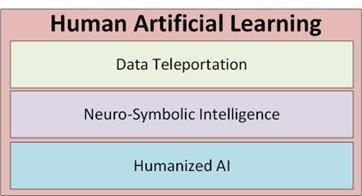
To accomplish the extraordinary capabilities and features of MOM requires an entire new form of artificial intelligence that more closely mirrors the intelligence and capabilities produced by the human brain.  Human Artificial Learning (HAL), as depicted in Figure 1, is a system that duplicates the brain’s algorithm and recreates elements of human behavior to direct a continuous stream of learning.  It turns out that the true nature of human intelligence rests in our ability to learn and adapt to an everchanging environment.  To achieve human-level artificial intelligence is centered around a single skillset, the human ability to learn.  HAL is a combination three different technologies: Data Teleportation, Neuro-Symbolic Intelligence, and Humanized AITM. When woven together they form a brand-new type of artificial intelligence with the human capability for learning.

Data Teleportation
DataTeleportation

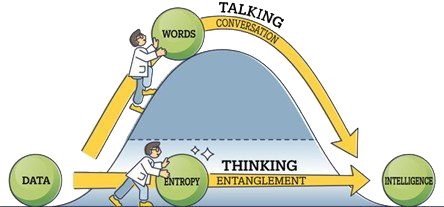
Data Teleportation is the theoretical instant transfer of information between two devices that are entangled. Resent research into the human intelligence process has shown that the brain is a quantum process that uses teleportation to optimize dataflow. The brain uses neurons, not quantum particles, to form an artificial entanglement to translate the enormous amount of sensory data into intelligence. The brain maintains a quantum state that produces real-time awareness where life can recognize its own existence at any moment in time. It uses that awareness to solve the big physics riddle in that entropy (uncertainty) can never be defeated and over time always increases. In the brain, sensory data is converted to entropy and intelligence evolved to decrease entropy over time as a matter of simple survival. The less entropy, the greater the survival rate.

Neuro-Symbolic Intelligence combines two forms of memory storage together to create human experience: semantic and episodic. Semantic memory is the symbols and emotions that are associated with any given block of episodic memory. Episodic memory is a time-series accumulation of raw data that is rhythmically measured. The two forms of memory together form a thought chain that can store human experience and organize that experience to produce various forms of intelligence.

Neuro-Symbolic Intelligence
Neuro-Symbol Intelligence is a memory and general processing framework for storing, searching, and matching human experience. Neuro-Symbolic Intelligence represents raw sensory data as a combination of neurological states and symbolic images. Symbols and images provide a means to generalized knowledge allowing entire concepts to be understood with a minimum set of memory encodings. Emotions serve to modulate the data allowing for different interpretations of the same data and allows data to be prioritized. Neuro-Symbolic Intelligence produces higher quality results that more precisely map the human experience by incorporating the many details, subtilties, and interrelationships that contribute to meaningful understanding.

Neuro-Symbolic Intelligence combines two forms of memory storage together to create human experience: semantic and episodic. Semantic memory is the symbols and emotions that are associated with any given block of episodic memory. Episodic memory is a time-series accumulation of raw data that is rhythmically measured. The two forms of memory together form a thought chain that can store human experience and organize that experience to produce various forms of intelligence.

Humanized AI

Humanized AI is the final technology needed to implement human-level artificial intelligence introducing human elements into the decision-making and learning process. Humans make decisions and learn very differently than current artificial intelligence. Artificial intelligence is about mathematics and probability assessment. While this is great for mimicking known repetitive tasks, it lacks the ability to continuously learn and adapt to new situations.

For humans, living is learning and performed by a process where experimentation is constantly performed to extract new knowledge and refine existing intelligence. This separation of learning and living is the most disturbing aspect of artificial intelligence because it presupposes that everything can be learned beforehand. Artificial intelligence and science in general have this problem where probability alone is used to estimate an outcome, merely identifying potential correlation and is nothing more than an educated guess. Human intelligence is based on actual causation where intelligence is constructed by learning and valuing observed cause and effect experiences, humans learn as they go and are constantly adapting.